5 Advanced Catan Strategy Tips to Dominate Your Next Game Night
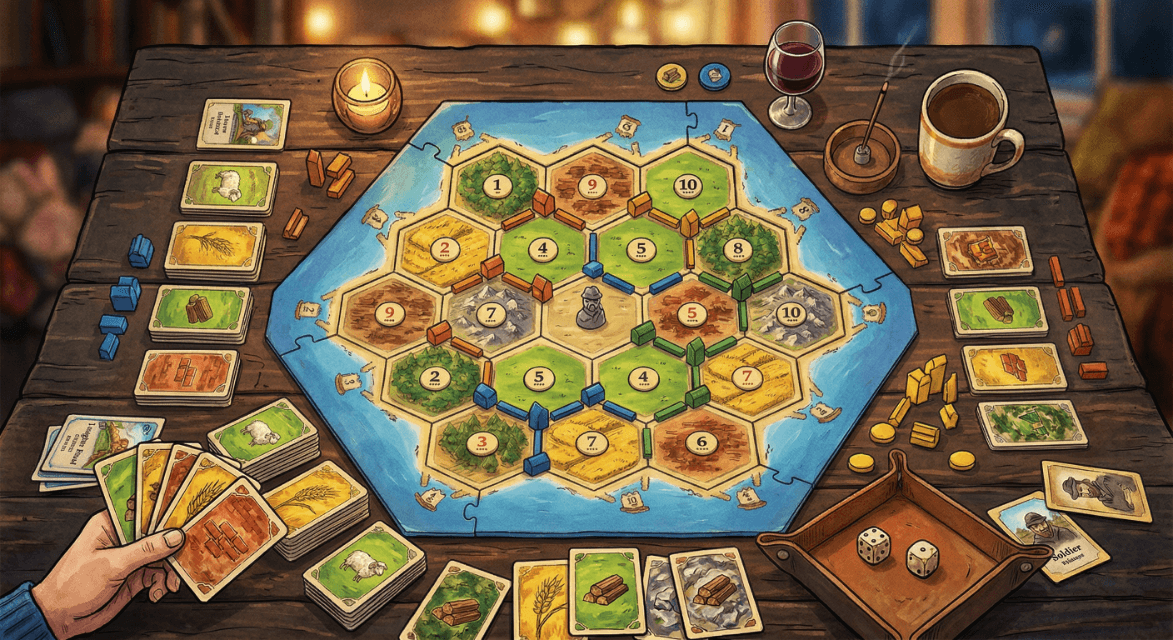
Securing consistent victories in Catan requires transitioning from relying on dice luck to mastering statistical probability and psychological warfare. While novice players chase the Longest Road and attempt to collect every resource type, tournament-level strategists approach the hexagonal board with a completely different mathematical mindset.
If you are tired of getting boxed in during the mid-game or watching your opponents steal the win with hidden Development Cards, it is time to upgrade your approach. The following strategies dissect the mathematics of board placement, resource normalization, and negotiation tactics to elevate your competitive play.
1. Avoid the "Resource Diversity" Trap
The most common beginner mistake is attempting to secure access to all five resources (Wood, Brick, Sheep, Wheat, and Ore) during the initial settlement placement. This often results in placing settlements on low-probability hexes merely to check a box.
Instead, your primary focus must be on maximizing pips. Pips are the small dots on the number tokens that indicate the $1/36$ probability of that number being rolled. A highly optimized placement prioritizes intersections with the highest total pip count, completely regardless of the resource type.
For example, securing an intersection of 5, 6, and 9 guarantees a massive flow of cards (13 pips total). A surplus of just two or three high-yielding resources combined with a strategic 3:1 port or a specific 2:1 resource port is a far more efficient economic engine than owning a meager trickle of all five resources.
2. Embrace the OWS (Ore-Wheat-Sheep) Meta
The competitive Catan ecosystem is heavily defined by the OWS strategy. While Wood and Brick are essential for early-game expansion, their utility plummets drastically in the late game. Conversely, Ore and Wheat become the most critical bottlenecks on the board.
Consider the resource mathematics required to reach 10 Victory Points efficiently. Upgrading to cities requires immense amounts of Ore and Wheat. Purchasing Development Cards requires Ore, Wheat, and Sheep. In an optimal path to victory, a player requires roughly 15 Ore and 13 Wheat, but only 4 Wood and 4 Brick.
Pro tip: Prioritize Wheat above all else. Because Wheat is required to build settlements, cities, and Development Cards, it mathematically possesses the highest normalized value of any resource in the game.
Players utilizing the OWS meta often possess shorter roads but rely heavily on Development Cards to secure the Largest Army and hidden Victory Points, quietly accelerating past opponents who are bogged down fighting over empty coastal territory.
3. Position in the Inner Ring
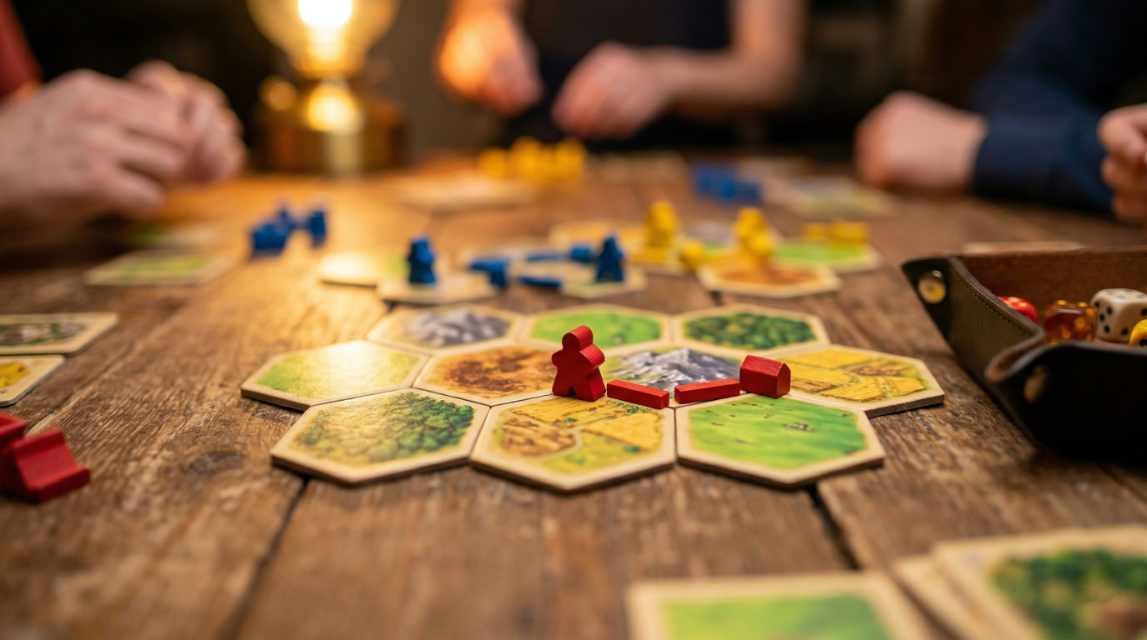
The geography of the Catan board functions in three distinct zones: the center, the inner ring, and the coastal ring.
Placing your first settlement directly on the coast is a severe tactical error. Coastal intersections border only one or two hexes, drastically limiting both your card production and your expansion optionality. The inner ring typically provides the optimal balance. It offers access to three productive hexes while leaving multiple viable pathways for road expansion, either toward the high-value center or outward to secure necessary maritime ports. Avoid the absolute center unless you have a clear, unblockable path out, as it is the easiest place to suffer from road suffocation.
4. Master the Art of Information Asymmetry
Catan is ultimately a game of social engineering. Mathematical advantages mean nothing if the entire table places a trade embargo on the perceived leader.
Never reveal exact card counts when a 7 is rolled. Information is a currency. When initiating a trade, expert players avoid announcing specific needs, which signals desperation. Instead, successful negotiators offer a card and ask for "anything" in return. This blind trade tactic uncovers what resources opponents hold without revealing your own strategic intentions.
Furthermore, managing threat perception is critical. The player who builds the Longest Road in the first few rounds inevitably attracts the Robber. Delaying obvious point grabs—such as keeping your third Knight card face down or leaving a road disconnected until the final turn—keeps your threat level low and your trade avenues open.
5. Optimize Your Robber Placements
The Robber is the most powerful tool for manipulating the game's macroeconomic state. When deciding where to place the Robber, the objective is not simply to penalize the player with the most points, but to disrupt the board's economy in your favor.
Block the leader's scarce resource: If the point leader desperately needs Ore to build a city, lock down their only Ore hex.
Do not block a resource you need: If the board lacks Brick, and you desperately need Brick to trade for, placing the Robber on the main Brick hex ensures that no one produces Brick, destroying any chance of a trade.
What to Try Next Game
During your next session, abandon the pursuit of the Longest Road. Focus entirely on securing high-pip Ore and Wheat hexes in the inner ring, acquire a 3:1 port early, and invest heavily in Development Cards. To set the perfect atmosphere, put on a deep ambient track from MeepleMelodies, and make sure to track your final score using the MeepleShelf score tracker to analyze how this vertical growth strategy drastically improves your late-game point generation.
Sign in to rate this post.
You Might Also Like

Comments
Sign in to leave a comment
Sign In