Board Game Genres Explained: The Ultimate Guide to Tabletop Mechanics
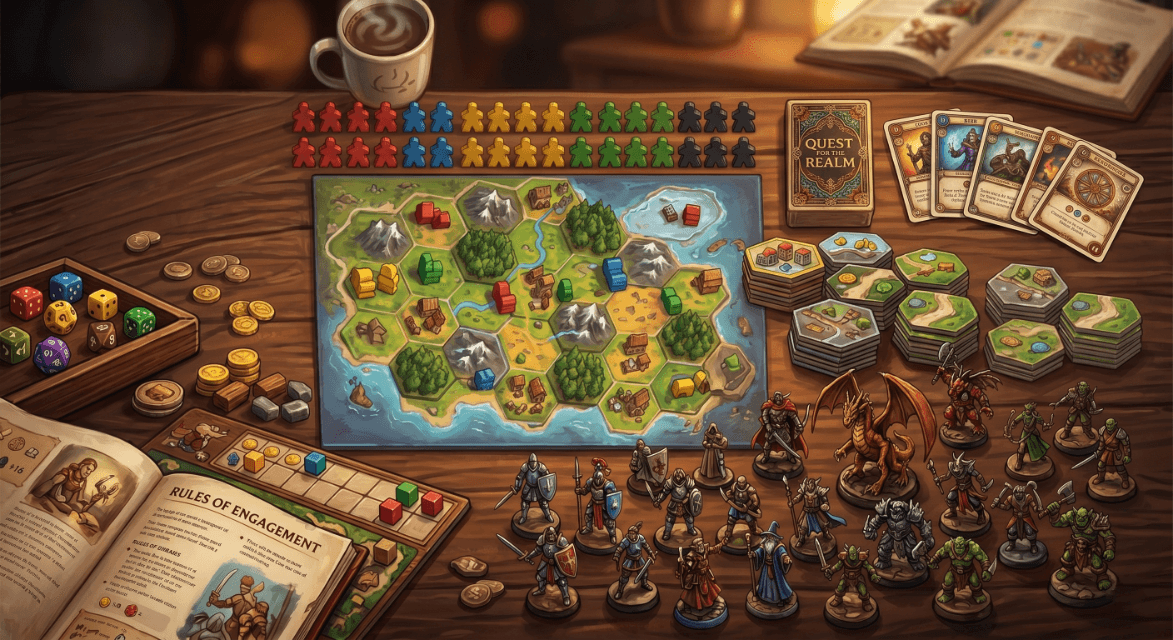
Navigating the modern tabletop landscape requires understanding the language of game mechanics. The board game industry has experienced explosive growth, evolving far beyond simple roll-and-move experiences into a complex ecosystem of blended mechanics and innovative gameplay loops. For newcomers, terms like "deck-building," "asymmetric," "4X," and "Eurogame" can seem like an impenetrable dialect utilized by veterans.
This comprehensive guide meticulously breaks down every major board game genre. By exploring how these genres function, what makes them engaging, and analyzing the quintessential examples that define them, you will learn exactly how to identify the games that match your group's playstyle.
The Grand Divide: Eurogames vs. Thematic Experiences
Historically, the tabletop world was broadly divided into two major philosophies of game design: the European style and the American style. While modern game design frequently blurs these lines, understanding this foundational divide is crucial.
Eurogames: Strategy Over Luck
Eurogames (often simply called "Euros") are heavily mechanical, mathematics-driven games that prioritize pure strategy over luck and aggressive conflict. Originating largely in Germany, these titles generally feature economic, agricultural, or historical themes where players manage limited resources to gain the most points.
The defining characteristic of a Eurogame is its reliance on passive competition. Players rarely attack each other directly; instead, they compete for limited resources, board space, or optimal actions. A classic gateway example is Ticket to Ride, where players manage hand capacity to claim railway networks across North America. The game's central tension relies on the balance between "greed" (drawing more cards for longer routes) and "fear" (losing a critical route to a competitor). Similarly, Viticulture and Agricola demonstrate the genre's focus on elegant mechanics, collective prosperity, and careful resource conversion over thematic immersion.
Thematic Games: Immersion and Conflict
Conversely, Thematic games—affectionately termed "Ameritrash" by some enthusiasts—prioritize dramatic narratives, direct conflict, and the thrill of chance. These games often rely heavily on dice rolling to resolve combat and utilize highly detailed miniatures. The goal is to create an immersive, cinematic experience where the theme dictates the mechanics. If a Eurogame is a finely tuned clock, a Thematic game is an explosive blockbuster movie.
Feature | Eurogames | Thematic Games |
Core Focus | Mechanics, efficiency, engine building | Narrative, theme, direct conflict |
Conflict Type | Passive (blocking spaces, taking resources) | Active (combat, attacking opponents) |
Luck Factor | Very low (perfect information) | High (dice rolls, card draws) |
Elimination | None (everyone plays until the end) | Common (players can be knocked out) |
Examples | Ticket to Ride, Viticulture | Descent, Warhammer 40,000 |
Card-Driven Ecosystems: Building Your Arsenal
Cards are arguably the most versatile components in tabletop gaming, but how those cards are acquired and utilized fundamentally shifts the genre.
Deck-Building
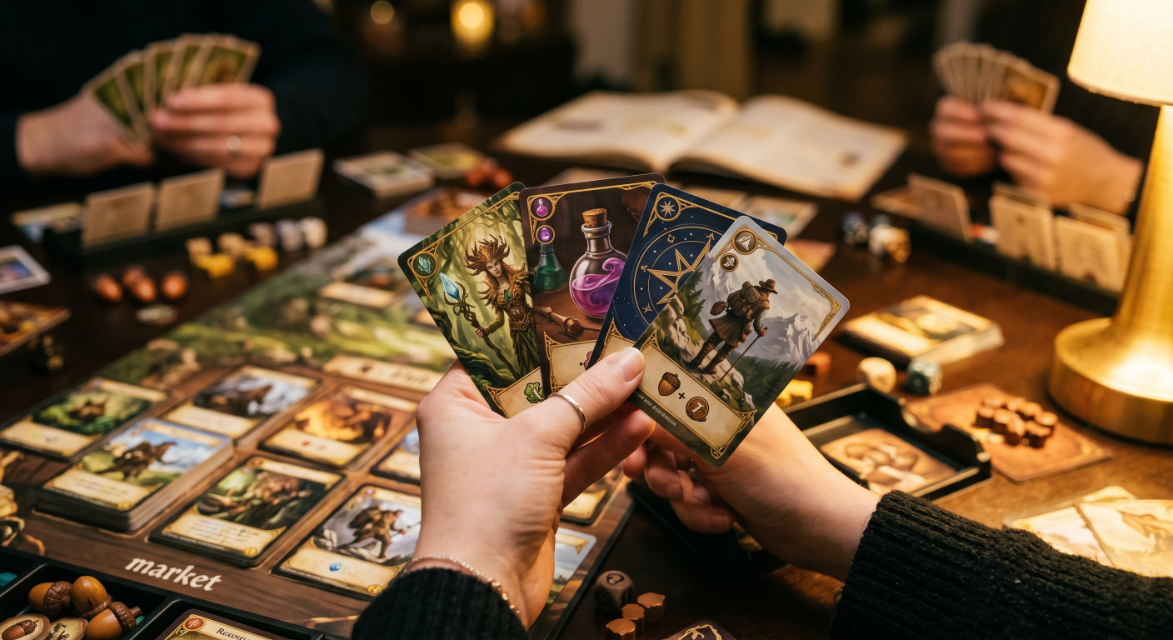
In a Deck-building game, the core gameplay loop is the construction of the deck. All players begin with an identical, rudimentary set of cards. During the game, players utilize these basic cards as currency to "buy" more powerful cards from a central, shared market, continually adding them to their personal deck.
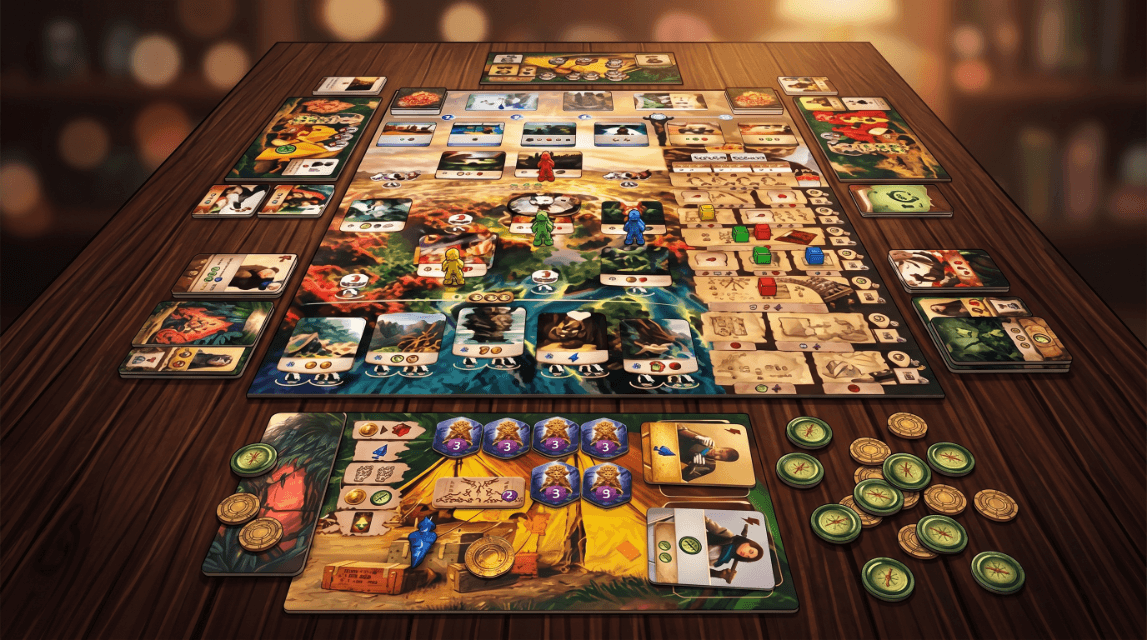
As the deck cycles and is reshuffled, players gain access to increasingly potent combinations, essentially building an "engine" to drive future plays. Dominion is universally recognized as the pioneer of this genre. Modern titles have evolved the formula by merging it with other mechanics; for instance, Lost Ruins of Arnak combines deck-building with worker placement, forcing players to manage a highly restricted deck size while exploring a mysterious 1950s-inspired island.
Trading Card Games (TCG) / Collectible Card Games (CCG)
Unlike deck-builders, Trading Card Games require players to construct their decks before the game begins. Players collect cards through randomized "blind packs" and carefully curate a competitive deck—typically 60 cards—designed to execute specific strategies against opponents.
Magic: The Gathering, released in 1993, is the grandfather of this genre. It introduced complex mechanics like "the stack" for reactive spellcasting and mana generation. The game supports vast formats, from "Standard" rotating sets to "Commander," where four players use 100-card singleton decks led by a legendary creature.
Pokémon TCG remains another colossal pillar. Players evolve creatures and manage energy resources to defeat an opponent's Active Pokémon, racing to claim six Prize cards or empty the opponent's bench. Because deck construction occurs outside of the gameplay session, TCGs represent a significant lifestyle and financial commitment.
Asymmetry and Engine Building
A major trend in modern tabletop design is empowering players with unique capabilities, ensuring that no two players approach the game identically.
Asymmetric Games
Asymmetric games are titles where players operate under completely different rules, starting conditions, or victory objectives. Unlike simple "variable player powers" (where players have a minor unique passive ability), true asymmetry means the fundamental gameplay experience changes depending on the chosen faction.
In Root, the asymmetry is profound: one player might control an expansive cat empire trying to maintain territory, while another plays as a single vagabond traversing the board completing quests, and yet another plays an insurgent woodland faction spreading rebellion. Spirit Island offers deep asymmetry in a cooperative setting, where different elemental spirits use drastically different mechanics to defend an island from invaders. Asymmetry ensures immense replayability, as mastering one faction does not equate to mastering the game.
Pro tip: When teaching an asymmetric game, assign the most straightforward, aggressive faction to new players. This allows them to grasp the core systems before tackling complex, rule-breaking factions that require deep systemic understanding.
Engine Builder
An Engine Builder is a game where players construct a system that exponentially increases their resource generation capabilities. A player might spend basic resources to build an asset, which then generates secondary resources every turn, which are eventually converted into victory points.
Wingspan exemplifies this perfectly. Players lay down bird cards in different habitats, and when an action is taken in a habitat, it triggers a chain of effects from every bird placed there, creating a powerful late-game engine. Terraforming Mars operates similarly on a macro scale, where players increase their production tracks over generations to eventually alter a planet's atmosphere.
Spatial Mastery: Area Control, 4X, and Wargaming
For players who enjoy spatial reasoning, territorial dominance, and tactical maneuvering, map-based games offer unparalleled strategic depth.
Area Control (Area Majority)
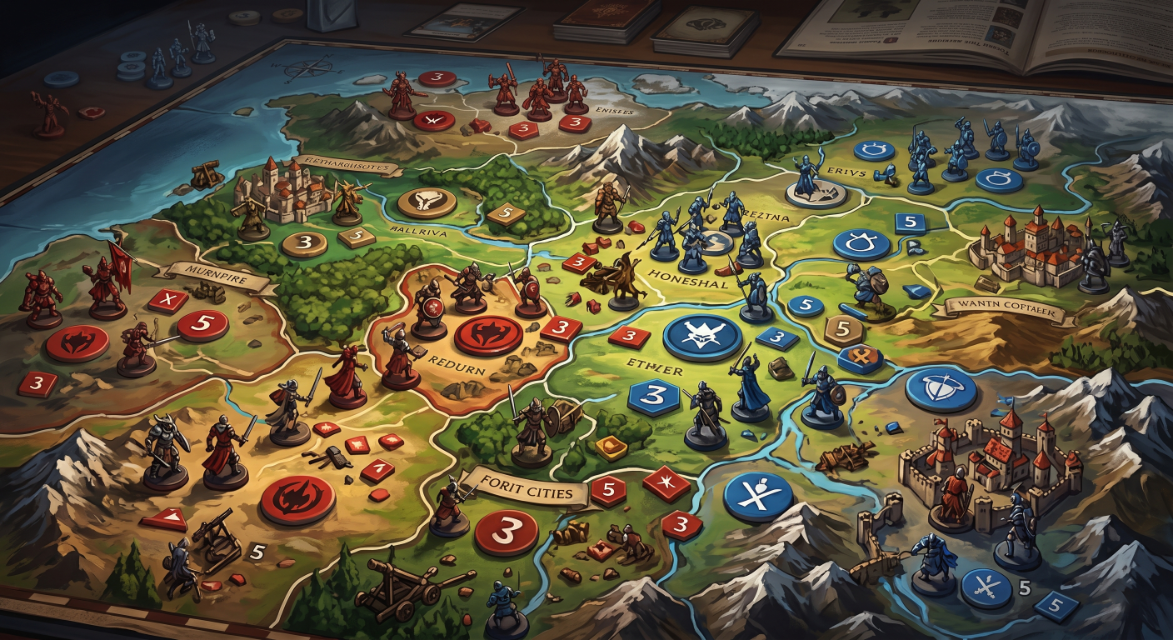
Often referred to as "dudes on a map," Area Control games require factions to compete for influence over specific geographic zones. Control is typically established by having the numerical majority of units in a region.
Cthulhu Wars is a massive, premium entry in this genre. Players control Lovecraftian cults (like the Yellow Sign or the Black Goat), navigating a "Gathering Power" phase before utilizing spellbooks to summon terrifying Great Old Ones. To win, players race to accumulate 30 Doom Points while ensuring all six of their unique spellbook powers are unlocked.
Kemet takes a highly aggressive approach to area control in ancient Egypt. Through Day and Night phases, players spend Prayer Points to acquire white, red, and blue power tiles, allowing them to summon magical creatures like the Sphinx or Giant Scorpion to lead their troops into battle.
4X (Explore, Expand, Exploit, Exterminate)
4X games are complex, civilization-building epics where players represent factions seeking ultimate power. Eclipse: Second Dawn for the Galaxy is a quintessential sci-fi 4X. Players explore hexagonal space sectors, research technologies (like Nano or Grid tech), and build highly customized spaceships using specific ship parts (Ion Cannons, Fusion Drives).
Sid Meier’s Civilization: The Board Game adapts the famous video game, allowing players to guide historical figures through ages. It perfectly captures the 4X ethos by offering four distinct paths to victory: Military, Technology (Science), Economy, and Arts (Culture).
Wargames
Wargames are highly tactical simulations of military conflict. Instead of a gridded board, wargames frequently utilize open tables where movement and weapon ranges are determined by physical measurement templates. Star Wars: X-Wing is a thrilling dogfight simulator where players secretly plan movements using unique maneuver dials. Ships execute Koiogran turns and barrel rolls to align enemies in their firing arcs, managing "stress" tokens when utilizing advanced red actions.
Narrative Immersion: Campaigns and Dungeon Crawlers
Not all games pit players against one another in a single sitting. Many genres focus on teamwork, ongoing storytelling, and persistent worlds.
Campaign and Legacy Games
Campaign games tell a continuous story divided into chapters played over multiple sessions. Players maintain the same characters, developing stats and abilities through experience.
Tainted Grail: The Fall of Avalon is a narrative masterpiece where players control outcast heroes navigating an island consumed by darkness (the Wyrdness). Every action costs energy, and combat is resolved through a unique card-chaining system matching specific icons (Courage, Spirituality, Magic).
Etherfields takes players into a shifting dreamscape where "Intent" cards (Move, Assault, Contact) are used to solve mysteries, navigate Slumber encounters, and avoid Distress.
A unique sub-genre is the Legacy game, where the physical components are permanently altered over the campaign. Players may place permanent stickers on the board or tear up cards, ensuring the game state becomes completely unique to that specific group.
Dungeon Crawlers
Dungeon Crawlers are scenario-based games where heroes navigate labyrinths, battle monsters, and collect loot. Gloomhaven is the undisputed king of this genre, utilizing an innovative card system where players choose two cards per turn, executing the top power of one and the bottom power of the other, while managing exhaustion as cards are permanently lost from their hands.
Descent: Journeys in the Dark offers an asymmetric twist: up to four heroes battle against a single "Overlord" player who controls the monsters. Combat utilizes custom dice pools where "Surge" symbols trigger devastating special effects.
Pure Logic to Pure Instinct: Abstract, Deduction, and Real-Time
Some genres strip away luck entirely, while others strip away turns, creating wildly different tabletop environments.
Abstract Strategy
Abstract games focus on purely informational aspects where the board conveys the complete state of the game, often with mathematical precision and zero luck.
Hive is a brilliantly simple yet deep abstract game played without a board. Players place hexagonal bug tiles, adhering to the "One Hive" rule (the pieces can never be disconnected) while utilizing unique movement patterns—like the Grasshopper leaping over pieces or the Dung Beetle crawling on top of them—to surround the opponent's Queen Bee.
Azul challenges players to draft beautiful ceramic tiles from factory displays. Players must carefully pattern their 5x5 grids to score bonuses while avoiding drafting excess tiles that result in score penalties.
Deduction
Deduction games turn players into investigators, gathering clues to solve puzzles or identify hidden traitors.
In Mysterium, one player acts as a completely silent ghost communicating with mediums. The ghost hands out large, surreal vision cards, and mediums must use pattern recognition to deduce the suspect, location, and weapon before a two-minute sand timer expires. Players even vote on each other's guesses using a clairvoyance track.
Chronicles of Crime modernizes the genre using a companion app and "Scan&Play" technology. Every physical component has a QR code, allowing players to interrogate suspects and explore virtual reality crime scenes using their smartphones.
Real-Time
Most board games are turn-based, but Real-Time games use a ticking clock as a constraint, forcing rapid action.
In Project: ELITE, players have exactly two minutes to frantically roll action dice to move and shoot approaching alien swarms. Rolling a "red crossroads" penalty forces the player to immediately advance an alien, adding immense pressure.
Captain Sonar pits two teams of up to four players against each other in a real-time submarine hunt. Segmented by a large screen, the Captain shouts movement orders while the Radio Operator simultaneously listens to track the enemy's path on a transparent sheet, creating an incredibly tense, chaotic environment.
Social Dynamics and Dexterity: Party and Physical Games
For environments characterized by high energy, laughter, and larger groups, the tabletop industry offers highly accessible alternatives.
Party Games
Party Games accommodate large player counts with minimal rules, thriving on social interaction, humor, and constraints.
Taboo challenges an active player to get their team to guess a target word, but they are forbidden from using five highly obvious "taboo" words printed on the card. If they slip up, the opposing team hits a buzzer.
Cards Against Humanity utilizes a "Card Czar" who reads a black prompt card, while other players submit white response cards to create the most humorous (and often offensive) sentence combinations, scoring "Awesome Points" for winning.
Dexterity
Dexterity games challenge physical coordination. ICECOOL requires players to actively flick weighted plastic penguins through a cardboard school layout. Players must execute trick shots, banking off walls or jumping over doorways, to catch fish tokens or evade the "Hall Monitor" player.
Setting the Perfect Game Night Atmosphere
Regardless of the chosen genre, the environment in which a game is played significantly impacts the experience. A heavy, thematic session of a Dungeon Crawler is vastly improved by dimming the lights and curating the right audio.
When organizing your next game night, pair your game's genre with suitable background music. We highly recommend utilizing the MeepleMelodies YouTube channel, which provides long, uninterrupted ambient tracks specifically tailored for tabletop gaming sessions. Whether you are orchestrating an epic space dogfight in X-Wing or quietly building your engine in Wingspan, the correct auditory backdrop prevents distractions and deeply enhances immersion.
Genre Reference Checklist
Use this quick-reference table to determine which genre to pull off your shelf based on your group's mood:
Genre | Player Intent | Core Mechanism | Quintessential Examples |
Eurogame | "I want to out-plan my opponents." | Resource management, efficiency, low luck | Ticket to Ride, Viticulture |
Deck-Building | "I want to create powerful card combos." | Expanding a starting deck via a market | Dominion, Lost Ruins of Arnak |
Asymmetric | "I want a unique faction with special rules." | Factions with completely different objectives | Root, Spirit Island |
Area Control | "I want to command an army on a map." | Dominating territories with unit majorities | Kemet, Cthulhu Wars |
Campaign | "I want an ongoing, epic story." | Persistent narrative and character progression | Gloomhaven, Tainted Grail |
Deduction | "I want to solve a mystery." | Interpreting clues, finding hidden information | Mysterium, Chronicles of Crime |
Real-Time | "I want fast-paced, stressful action." | Simultaneous play governed by a strict timer | Captain Sonar, Project: ELITE |
Understanding these genres is the ultimate tool for curating your collection. By recognizing the mechanics that bring your gaming group the most joy, you can consistently identify titles that will hit the table time and time again.
Sign in to rate this post.
You Might Also Like
Comments
Sign in to leave a comment
Sign In