Catan Board Game Review: Is the 1995 Pioneer Still Worth Playing in 2026?
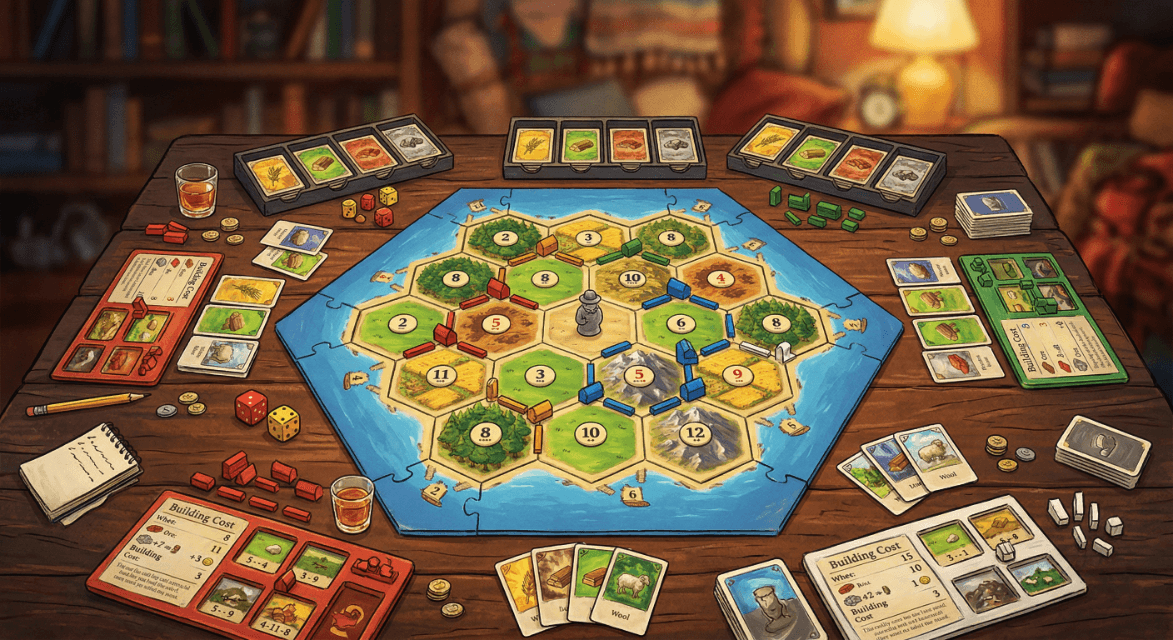
Catan is the undisputed living ancestor of the modern tabletop industry. Originally published in 1995 by Klaus Teuber, this groundbreaking title shattered the paradigm of cutthroat player elimination, introducing a global audience to systemic resource management, constructive expansion, and peaceful—yet fiercely competitive—social negotiation.
Fast forward to 2026, and the board gaming landscape has transformed dramatically. We are now surrounded by mechanically dense engine-builders, zero-luck strategy games, and sprawling narrative campaigns. With over 45 million copies sold worldwide, the question is no longer whether Catan is historically significant. The real question is: does this thirty-year-old classic still deserve physical space on your gaming shelf, or has it been completely superseded by modern designs?
The Architecture of the Island
The brilliance of Catan emerges during the setup phase, long before the first dice are ever rolled. The game utilizes a modular, randomized hexagonal grid, ensuring that no two islands ever present the exact same economic landscape. Each terrain hex yields one of five essential resources—wheat, sheep, wood, brick, or ore.
Crucially, this yield is entirely dictated by the mathematical probability of rolling two six-sided dice (2d6). Placing your initial settlements is a test of statistical risk assessment. You must analyze the board to balance probability density (the "pips" on the numbers) against resource diversity. Placing a settlement on an 8 or a 6 guarantees high frequency, but ignoring specific resources entirely can cripple your late-game engine.
Pro tip: Prioritizing high-yield ore and wheat hexes during your initial placement establishes a formidable foundation for acquiring Development Cards and upgrading to Cities—often considered the most mathematically consistent path to 10 Victory Points.
The Social Economy and Trading Dynamics
While the dice dictate the raw generation of resources, it is the social economy that truly dictates victory. It is mathematically improbable for a single player to maintain self-sufficiency across all five resource types. This scarcity mandates constant negotiation, bartering, and diplomacy.
This trading mechanic ensures that players remain highly engaged even when it is not their turn. However, this reliance on social trading operates as a double-edged sword. If the table recognizes a clear leader, a trade embargo quickly forms. The game relies heavily on players fully engaging with its systems; if trades stall and players hoard cards, the economic engine grinds to a halt. When this happens, you are forced to rely on inefficient 4:1 maritime trades, and the game's pacing can severely drag.
Advanced Meta and House Rules
To mitigate the inherent variance of the dice and the friction of trade embargoes, the global community has developed an extensive meta-game and popular "House Rules."
Many veteran groups employ systems like Poverty Tokens—awarding a token whenever a roll yields no resources for a player, which can eventually be traded for goods. Others utilize the Welfare system or the Farming Robber, allowing players to glean resources when placing the robber on unsettled territory. While purists argue these mechanics disrupt the carefully balanced scarcity designed by Teuber, they demonstrate the community's desire to modernize the game's luck factor.
Evaluating the 2025 Sixth Edition
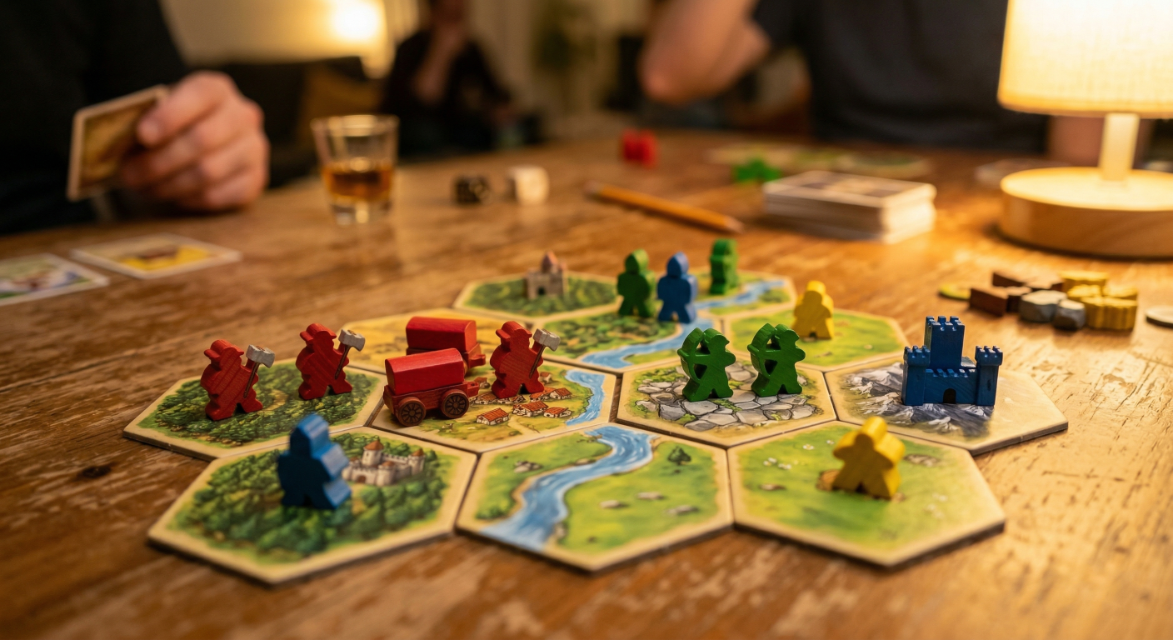
Marking the title's 30th anniversary, the publisher released the highly anticipated 6th Edition in 2025. The core mechanical framework remains entirely untouched, ensuring backward compatibility in gameplay, but the visual and material components received significant updates.
The terrain hexes now feature a modernized gradient aesthetic, providing a softer, more contemporary visual identity compared to the flat art of the 5th edition. Typographical elements across the probability discs have been refreshed, and the classic "Longest Road" achievement has been officially rebranded as the "Longest Route."
However, component adjustments have introduced minor friction points. The beloved standalone harbor tokens have been eliminated entirely. More concerning for legacy collectors is the transition in some regional prints of expansions (like Cities & Knights) from wooden pieces to plastic components. Mixing a 5th edition wooden base game with 6th edition plastic expansions creates jarring visual and tactile inconsistencies, and the altered designs of commodity cards can inadvertently let players track what opponents are holding.
The Final Verdict: Is it Worth It?
Comparing Catan to the cutting-edge mechanics of modern releases reveals a relatively "thin" systemic loop. Advancements in game design have compartmentalized and refined its ideas—route building is more fluid in Ticket to Ride, and resource generation has been stripped of its frustrating dice variance in newer Eurogames.
Feature | The Advantages | The Drawbacks |
Mechanics | Simple to grasp with surprising tactical depth and a modular board. | High reliance on dice probability can frustrate competitive optimization. |
Interaction | Constant social negotiation keeps all players engaged on every turn. | A stubborn table refusing to trade can artificially stall the game length. |
Components | The 6th Edition offers beautiful gradient art and clean typography. | Mixing 5th and 6th edition expansions creates severe material inconsistencies. |
Scalability | Endlessly expandable via heavy modular sets like Cities & Knights. | The base game strictly demands a four-player count for optimal tension. |
The bottom line: The tabletop industry has undoubtedly evolved past 1995, but Catan endures as a masterclass in collaborative mathematical setup and cutthroat economic execution. While it may no longer be the only game you need to own, it remains the ultimate gateway experience. It functions perfectly as the bridge between casual family game nights and serious hobbyist strategy, earning its permanent spot on the shelf.
Sign in to rate this post.
You Might Also Like
Comments
Sign in to leave a comment
Sign In