How to Play and Score Lost Ruins of Arnak: A Complete Beginner's Guide
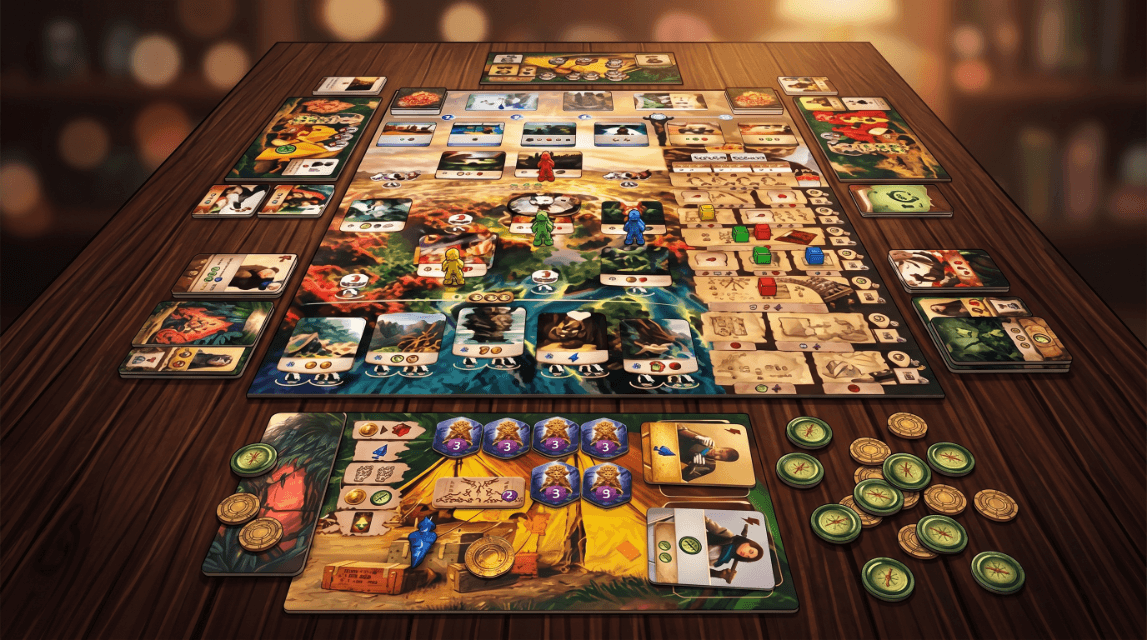
The uncharted island of Arnak is calling, and your expedition is about to face its greatest challenge. Combining the strategic depth of deck-building with the tight tactical constraints of worker placement, Lost Ruins of Arnak is a race to uncover lost artifacts, map treacherous jungles, and outwit fearsome guardians.
If the massive game board and sprawling components seem intimidating, don't worry. This guide breaks down exactly how to set up your camp, execute your actions, and calculate your final victory points. By the end of this read, you'll be ready to lead your archaeologists to glory—and you can track your entire expedition's success right here using the MeepleShelf score tracker.
1. Preparing Your Expedition (Setup)
Before you can explore the ruins, you need to establish your base camp. Lost Ruins of Arnak features an asymmetrical setup designed to balance the game based on turn order.
First, determine the starting player by identifying who most recently traveled to a place they had never visited before. Once established, distribute the starting resources based on player order:
First Player: 2 Coins
Second Player: 1 Coin, 1 Compass
Third Player: 2 Coins, 1 Compass
Fourth Player: 1 Coin, 2 Compasses
Every player receives an identical starting deck of six cards: four basic cards in their chosen color and two Fear cards. Shuffle this deck and place it face down on your player board. Draw your starting hand of five cards. Place your two archaeologist figures in your personal supply, and position your magnifying glass and notebook tokens at the bottom of the central Research Track.
2. The Anatomy of a Round
A complete game consists of exactly five rounds, tracked by the movement of the cardboard Moon Staff across the top of the board.
During a round, players take turns in clockwise order. On your turn, you must perform exactly one Main Action, along with any number of Free Actions (indicated by a lightning bolt icon). You continue taking turns until you choose to pass, indicating you are done for the round.
Once all players have passed, the round ends. You must shuffle all cards from your active play area and place them at the bottom of your draw deck. The Moon Staff advances, altering the market balance by making Artifacts more prominent than Items, and the starting player marker shifts to the left.
Pro tip: Pay close attention to the cards you purchase. Because they go to the bottom of your deck instead of a discard pile, you can deterministically calculate exactly when they will arrive in your hand.
3. Executing Main Actions
The core puzzle of Arnak is deciding which action provides the most value at the perfect time. On your turn, choose one of these five Main Actions:
Dig at a Site
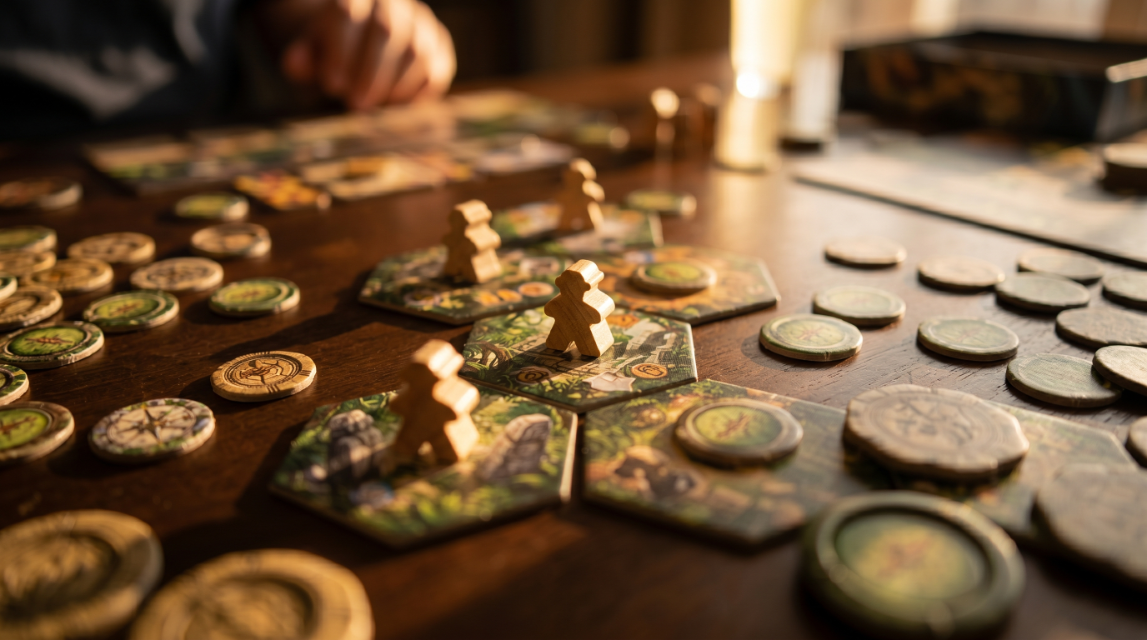
Play a card from your hand that matches the required travel icon (a boot, boat, car, or airplane) to place one of your archaeologists on a previously discovered site. You immediately collect the resources printed on that space.
Discover a New Site
Spend the required number of Compasses (3 for a Level 1 site, 6 for a Level 2 site) and play the correct travel icon to send an archaeologist into the unknown. When you do this, you collect the idol token present, draw a new site tile, instantly gain its resources, and awaken a Guardian.
Overcome a Guardian
Guardians block your archaeologists and instill fear. If your archaeologist is on a site with a Guardian, you can spend the exact resources depicted on the Guardian tile to overcome it. This grants you 5 Victory Points at the end of the game and a powerful one-time boon you can use on a future turn. If you leave your archaeologist with an undefeated Guardian at the end of the round, you take a negative Fear card.
Buy a Card
You can purchase Item cards (using Coins) or Artifact cards (using Compasses) from the central market row.
Items go directly to the bottom of your draw deck.
Artifacts also go to the bottom of your deck, but you immediately resolve their primary effect for free the moment you buy them.
Research
Pay the resource costs indicated on the next space of the Research Track to advance your magnifying glass or notebook. Advancing grants immediate rewards, unlocks powerful Assistants, and ultimately leads to the lost temple. Your notebook can never advance higher than your magnifying glass.
Pro tip: Assistants unlocked on the Research Track provide a free, recurring action every single round. Pushing your magnifying glass up the track early in the game to secure an Assistant pays massive dividends over five rounds.
4. How to Score Lost Ruins of Arnak
Lost Ruins of Arnak is a classic "point salad" game—almost everything you achieve contributes to your final score. When the fifth round concludes, tally your points across these specific categories.
Scoring Category | How it works |
Research Track | Score the points printed next to the final resting place of your magnifying glass and notebook tokens. |
Temple Tiles | If you reached the top of the Research Track, you score points for any specific temple tiles you purchased. |
Idol Tiles | Score the base points for collected idols. You also score points for any idol slots left uncovered on your player board. |
Guardians | Every Guardian tile you successfully overcame is worth exactly 5 points. |
Cards & Fear | Add up the positive victory points printed on all Items and Artifacts in your deck. Subtract 1 point for every Fear card you possess. |
Calculating these totals manually can lead to frustrating math errors at the end of a long game night. To make this seamless, use the MeepleShelf Lost Ruins of Arnak Score Tracker. It features dedicated input fields for all five of these exact categories, does the math instantly, and saves your game history so you can finally prove who the ultimate explorer really is.
5. Solo Mode Rules (The Automa)
If your gaming group is busy, Arnak features an excellent solo mode driven by a simulated "Rival" archaeologist. The Rival operates via a deck of action tiles that dictate its moves.
The Rival does not collect resources. Instead, when its tile is drawn, it simply occupies worker placement spots, advances forcefully up the research track, or sweeps cards from the market. At the end of the game, the Rival scores points based on its position on the track, the cards it hoarded, and the idols it collected. You can adjust the difficulty by swapping in red tiles, which typically inflate the Rival's final score by 5 to 7 points each.
Ready to explore? Set up the board, grab your starting resources, and open the MeepleShelf score tracker on your phone before you take your first turn.
Sign in to rate this post.
You Might Also Like
Comments
Sign in to leave a comment
Sign In