Lost Ruins of Arnak Review: The Ultimate Worker Placement and Deck-Building Hybrid
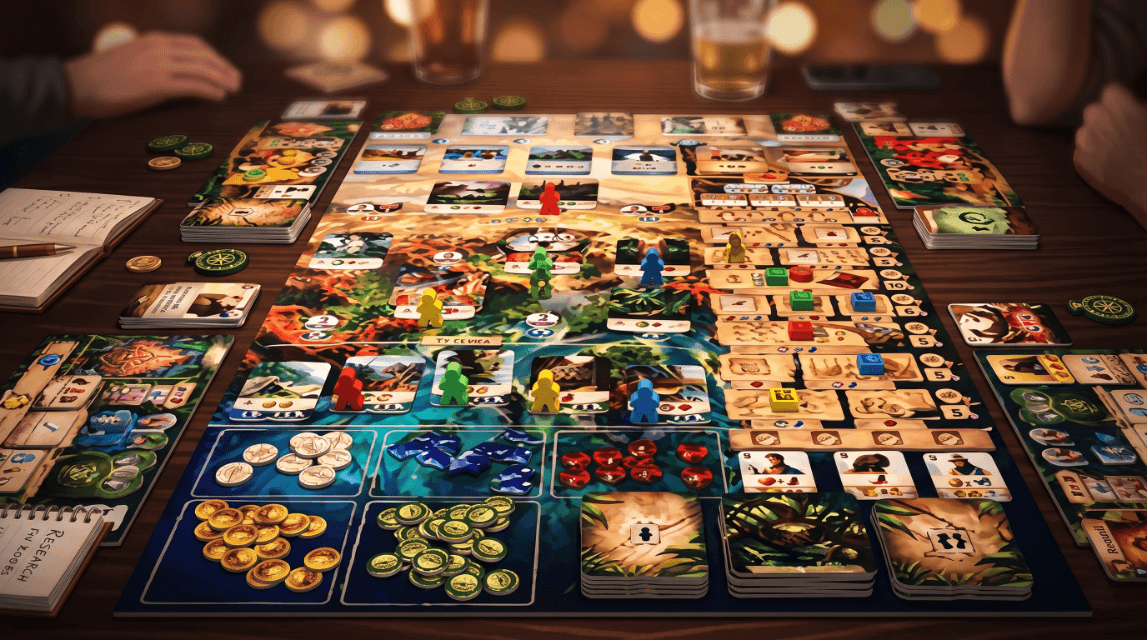
The tabletop industry is notorious for attempting to smash popular mechanics together, often resulting in bloated, unfocused gameplay that collapses under its own weight. So when Czech Games Edition released Lost Ruins of Arnak in 2020—boldly claiming to seamlessly integrate worker placement, deck-building, and resource management into a single cohesive adventure—the skepticism was justified.
Designed by the husband-and-wife duo Mín & Elwen, this game puts you in the boots of an expedition leader exploring an uncharted island filled with forgotten artifacts and mythical guardians. But does it actually deliver on the promise of thrilling archeological discovery, or is it just another dry Euro-game disguised with a fresh coat of jungle paint? After extensively tracking scores and analyzing countless play sessions, the answer is a fascinating mix of both.
The Mechanics of Exploration
At its core, Lost Ruins of Arnak is a game of extreme economic efficiency. You begin with a tiny, incredibly weak deck of cards and a team consisting of exactly two archaeologist meeples. You only have five rounds to explore the island, fight guardians, research the lost temple, and acquire new cards.
The primary tension stems from a brilliant restriction: you can only perform one main action per turn.
This creates an agonizing, beautiful sequence of risk assessment. Do you use your limited compasses to discover a new jungle site before your opponent gets there? Or do you prioritize spending those compasses on a powerful new artifact card that might disappear from the market? Because you only have two meeples, the traditional worker placement blocking mechanisms are tight, meaning turn order and timing are absolutely critical to success.
The resources you are managing—coins, compasses, stone tablets, arrowheads, and rubies—are constantly flowing in and out of your supply. Arrowheads, in particular, act as a notorious bottleneck in the early game. Securing them usually dictates who gains the upper hand in the crucial first three rounds.
The Moon Staff and Instant Gratification
Where Arnak truly innovates is in its approach to deck-building, primarily through the Moon Staff market mechanism.
The market row consists of two types of cards. On the left are Items, which cost coins. Like traditional deck-builders such as Clank! or Dominion, purchased items go to the bottom of your deck, meaning you have to wait to draw them. On the right side are Artifacts, which cost compasses.
Artifacts are the secret engine of Arnak. When you purchase an artifact, its effect triggers immediately and for free.
This design choice eliminates the sluggish pacing often associated with deck-builders. It allows you to pull off incredible, chain-reaction turns. You might find yourself one tablet short of advancing on the research track, only to buy an artifact that instantly generates that tablet, allowing you to advance, which then gives you a coin, which you then use to buy an item.

The Research Track Dilemma
While the game heavily promotes the theme of exploring the jungle and battling terrifying guardians, the mechanical reality of Arnak is somewhat different. The beating heart of the game—and your primary source of victory points—is the Research Track.
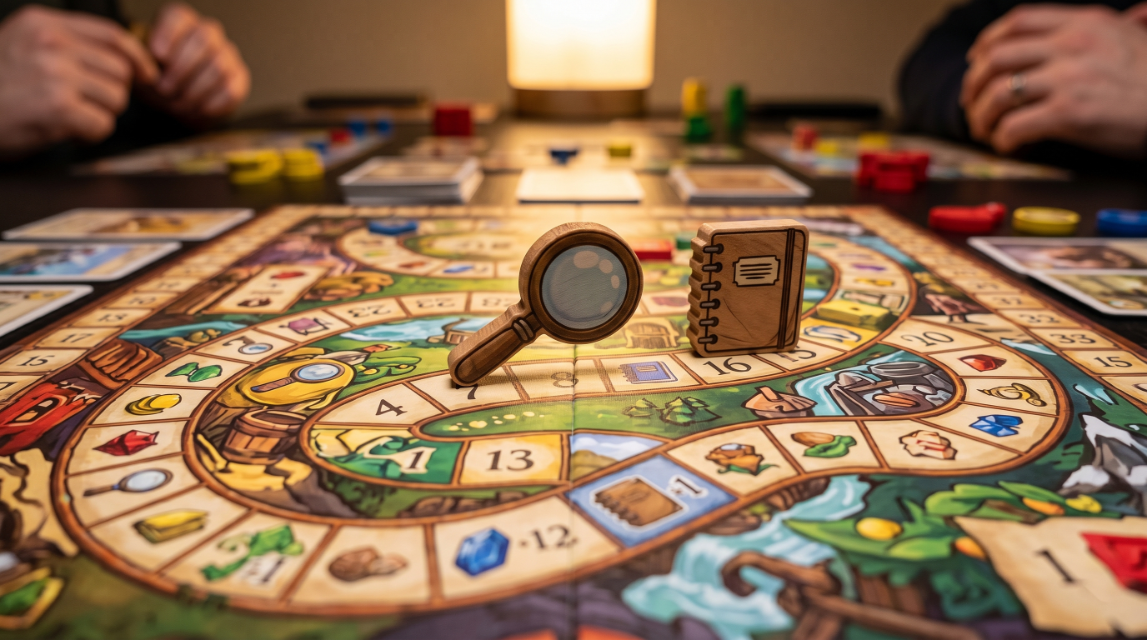
You must spend specific combinations of resources to advance your magnifying glass and notebook tokens up a linear track toward the lost temple. Advancing not only yields massive points but also unlocks assistants (workers who give you a free resource every round).
However, this track is the source of the game’s most prominent critique. In the base game, focusing heavily on the "Bird Temple" research track is almost always the optimal path to victory. It is entirely possible to ignore the fun parts of the game—exploring new sites and buying cool cards—and instead just play an incredibly dry game of converting resources into research steps. When played optimally, the exhilarating Indiana Jones theme fades, revealing a rigid, albeit satisfying, mathematical puzzle.
Pro tip: Always ensure your magnifying glass token advances before your notebook token. The notebook cannot physically bypass the magnifying glass on the track, and advancing the magnifying glass first often unlocks the exact resources you need to pay for the notebook's advancement.
The Expansion Solution: Expedition Leaders
If the base game's linear research track sounds like a deterrent, there is a silver lining that elevates this game to a masterpiece. The Expedition Leaders expansion completely fixes every minor flaw in the base game.
This expansion introduces asymmetric player powers. Instead of everyone starting with the exact same deck, you might play as The Captain (who gets three meeples instead of two) or The Mystic (who actively wants to acquire negative Fear cards to fuel dark rituals).
More importantly, it introduces alternate research tracks like the Snake Temple. These new tracks actively disrupt the "rush to the top" strategy by placing guardians directly on the research path, forcing players to engage with combat and exploration to progress. If you are purchasing Lost Ruins of Arnak, consider the Expedition Leaders expansion an absolutely mandatory addition.
Scoring Your Expedition
Because Arnak is a quintessential "point salad" game, scoring at the end of the fifth round can be a tedious exercise in arithmetic. You must calculate points from your research track, temple tiles, idols collected, guardians defeated, and the point values printed on every card in your deck, all while subtracting points for any Fear cards you acquired.
This is where digital tools become invaluable at the table. Using the dedicated MeepleShelf score tracker directly on your phone completely eliminates the end-game math fatigue. The tracker features a custom template specifically built for Arnak's six scoring categories, allowing you to punch in your totals in seconds and instantly see who mastered the island. A solid competitive score generally sits in the mid-70s, while highly optimized turns can push a player past the 90-point threshold.
The Final Verdict
Lost Ruins of Arnak is a masterclass in mechanical integration. It plays in a brisk 90 minutes, scales beautifully from 1 to 4 players, and features some of the best production quality seen in modern board gaming.
Feature | The Good | The Bad |
Mechanics | Flawless blending of worker placement and deck-building. Artifacts triggering instantly is a genius design choice. | The base game research track heavily rewards a single, straightforward strategy. |
Theme | Gorgeous artwork, premium components, and intense thematic tension when revealing a new guardian. | Ultimately, it boils down to a resource conversion puzzle, which might disappoint pure adventure seekers. |
Pacing | Limiting players to one action per turn keeps the game moving rapidly with almost zero downtime. | Decks stay very small, meaning you won't pull off massive 10-card combo turns. |
Should you buy it?
If you love games that reward extreme efficiency, tight resource management, and tactical optimization, Lost Ruins of Arnak deserves a permanent spot on your shelf. It perfectly bridges the gap between accessible family-weight games and heavy brain-burners. However, if you are strictly looking for a narrative adventure game, the heavy focus on resource conversion math might leave you feeling a bit disconnected from the jungle theme.
Just remember: pack your compasses, watch out for the guardians, and don't forget to track those hard-earned victory points.
Sign in to rate this post.
Comments
Sign in to leave a comment
Sign In