The 2026 Spiel des Jahres: Industry Shifts, Empathetic Design, and Reiner Knizia's Historic Triple Crown
The global tabletop gaming industry witnessed a historic convergence of milestones on July 12, 2026, during the prestigious Spiel des Jahres (Game of the Year) awards ceremony held at the nhow Hotel in Berlin. Recognized universally as the most influential accolade within the board game sector, the 2026 event highlighted a definitive paradigm shift in modern game design. The jury's selections across all three major categories demonstrated a concerted industry movement toward accessible rulesets, empathetic player interaction, and constructive planning, moving decisively away from aggressive conflict mechanics.
The ceremony not only elevated international voices from emerging tabletop markets to the global stage but also cemented the legacy of one of the medium's most prolific creators. Comprehensive market analyses indicate that the outcomes of the 2026 awards will dictate publisher strategies, retail distribution networks, and consumer purchasing patterns for the forthcoming fiscal year.
The Economic Engine of the "Red Pawn"
To understand the gravity of the 2026 announcements, it is necessary to examine the economic mechanics of the Spiel des Jahres award. Established in 1978 by a dedicated jury of German-speaking board game critics from Germany, Austria, and Switzerland, the award was originally conceived to promote high-quality, family-friendly game design within the German market. Over the decades, it has evolved into a global economic powerhouse.
The tabletop industry is characterized by a massive volume of annual releases, making discoverability a primary challenge for publishers. The Spiel des Jahres serves as a critical curation mechanism. Data indicates that a standard successful board game release typically moves between 500 and 3,000 units during its initial print run. However, the economic multiplier effect of the Spiel des Jahres is staggering.
Award Status | Estimated Unit Sales | Market Impact |
Standard Release | 500 – 3,000 copies | Base market penetration, limited to hobbyist channels. |
Award Nominee | ~10,000 copies | Expanded distribution, entry into specialized retail chains. |
Award Winner | 500,000+ copies | Mass market saturation, international localization, perennial catalog status. |
The "Red Pawn" logo printed on a game's box acts as a seal of absolute quality for the mass market, effectively bridging the gap between hobbyist enthusiasts and casual family consumers. Consequently, the announcement of the 2026 winners immediately triggered massive reprint orders, rapid international licensing agreements, and aggressive retail positioning ahead of the holiday season.
Spiel des Jahres: The Triumph of Empathy in Dito!
The main prize, the Spiel des Jahres 2026, was awarded to Dito! (published internationally under the title JinxO), a word association party game designed by Indonesian creator Martin Ang. The victory of Dito! represents a fascinating evolution in party game mechanics and highlights the increasing globalization of the board game industry.
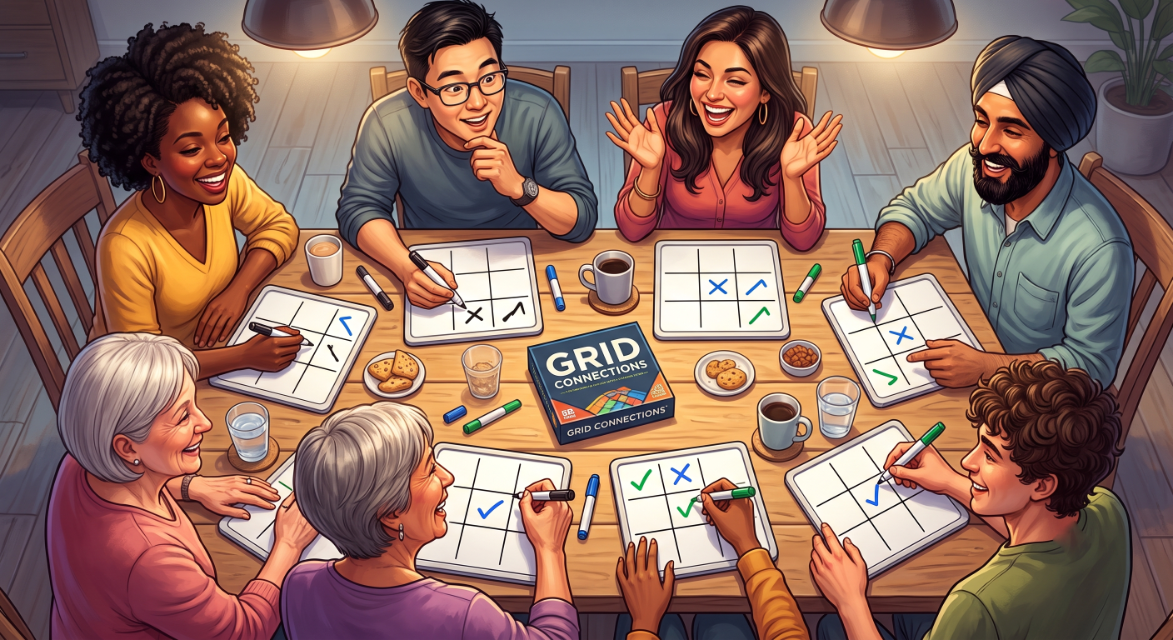
The fundamental architecture of Dito! centers on a nine-square grid where players enter responses based on specific prompt categories, ranging from "Countries with good cuisine" to "Things people would sell their soul for". Unlike traditional trivia games that test objective knowledge, Dito! requires players to predict what exactly one other person at the table will write.
The jury's statement explicitly praised this mechanical shift. The analysis noted that while the game appears to be a standard point-scoring competition, its core engine forces participants to focus on shared commonalities and emotional intelligence. Success in Dito! is completely reliant on understanding the perspectives, cultural touchstones, and associative logic of fellow players. This design philosophy aligns perfectly with the jury's stated mission of honoring games that are accessible, innovative, and capable of bringing diverse groups of players together around the table.
The publication history of Dito! further illustrates shifting industry dynamics. Originally developed and championed within the Indonesian board game community, the game was published internationally by Tabletoys Games and brought to the German-speaking market by Game Factory. Martin Ang's victory not only validates the creative output of the Southeast Asian tabletop scene but also demonstrates the Spiel des Jahres jury's willingness to look beyond traditional European design hubs.
2026 Spiel des Jahres Nominees | Designer | Publisher | Core Mechanism |
Dito! (JinxO) (Winner) | Martin Ang | Game Factory / Tabletoys | Word Association, Empathy |
Cozy Sticker Ville | Corey Konieczka | Unexpected Games | Sticker Placement, Conversation |
Morty Sorty Magic Shop | Markus Slawitscheck | Schmidt | Sorting, Pattern Recognition |
The nominees in this category, including Corey Konieczka's Cozy Sticker Ville and Markus Slawitscheck's Morty Sorty Magic Shop, shared a common thread of low-friction rulesets designed to foster constructive, peaceful environments. The explicit praise for Cozy Sticker Ville as a "peaceful time-out" reinforces the market's growing appetite for stress-reducing analog activities.
Kennerspiel des Jahres: Reiner Knizia's Unprecedented Triple Crown
The most analytically significant event of the 2026 ceremony occurred within the Kennerspiel des Jahres (Connoisseur Game of the Year) category. The award was given to Rebirth, a strategic tile-placement game designed by Dr. Reiner Knizia and co-published by Frosted Games and Mighty Boards.
This victory cemented a historic milestone: Reiner Knizia became the first and only game designer in history to win all three major Spiel des Jahres awards. To fully grasp the magnitude of this achievement, one must examine the chronological evolution of the awards and Knizia's prolific career.
Born in 1957 in Illertissen, Bavaria, Knizia holds a Ph.D. in mathematics and worked in software development and banking before transitioning to full-time game design in the late 1990s. His analytical background deeply informs his design philosophy, which focuses on stripping away extraneous rules until only a highly elegant, mathematically sound core remains. With over 800 published games translated into more than 2,000 editions worldwide, his influence on modern game design is unparalleled.
The Knizia Triple Crown | Award Won | Year | Core Mechanism | Target Audience |
Keltis | Spiel des Jahres | 2008 | Card Management, Push-Your-Luck | Family / Casual |
Wer war's? | Kinderspiel des Jahres | 2008 | Cooperative, Electronic Integration | Children |
Rebirth | Kennerspiel des Jahres | 2026 | Tile Placement, Route Building | Enthusiast |
The Kennerspiel des Jahres was formally established in 2011 to address a growing segment of the market that desired more complex, strategic experiences than the family-oriented main award typically provided. Knizia's ability to adapt his signature elegant design style to satisfy the demands of this heavier strategic category, 18 years after his initial dual victories in 2008, demonstrates remarkable versatility.
The Solarpunk Architecture of Rebirth
Rebirth distinguishes itself through a unique thematic and mechanical synthesis. Set in a futuristic, post-disaster Scotland, players represent clans attempting to rebuild their homeland utilizing sustainable, solarpunk technologies. Accompanied by striking illustrations by Anna Przybylska and Kate Redesiuk, the game subverts traditional post-apocalyptic tropes by focusing entirely on harmony, ecological restoration, and constructive development.
Mechanically, the game plays in a brisk 30 to 60 minutes and supports 2 to 4 players. Each turn is deceptively simple: a player draws a tile and places it on a shared board. Depending on the placement, the tile triggers specific scoring opportunities or enhances the player's engine for future turns. The jury praised this architecture, noting that the simple core principle opens up a vast decision space, forcing players to focus on essential, long-term planning. The shared board creates intense but indirect competition, resulting in an interactive experience where constructive strategy takes precedence over destructive interference.
The victory also represents a monumental business achievement for the German publisher Frosted Games. By winning the Kennerspiel des Jahres in 2026 with Rebirth, following their 2025 win with Endeavor: Deep Sea, Frosted Games became the first publisher in the history of the award to secure back-to-back victories in the enthusiast category. This cements the publisher's reputation as a premier curator of mid-weight strategic titles within the European market.
2026 Kennerspiel des Jahres Nominees | Designer | Publisher | Core Mechanism |
Rebirth (Winner) | Reiner Knizia | Frosted Games / Mighty Boards | Tile Placement, Engine Building |
Boss Fighters QR | Michael Palm & Lukas Zach | Pegasus Spiele | Cooperative Combat |
Moon Colony Bloodbath | Donald X. Vaccarino | Alea / Rio Grande Games | Disaster Management, Survival |
Kinderspiel des Jahres: Fostering Early Strategic Development
The Kinderspiel des Jahres (Children's Game of the Year), an award category formalized in 1989, recognizes excellence in game design aimed at younger audiences. The 2026 award was presented to Die Insel der Mookies (Mooki Island), an enchanting two-player duel designed by French author Florian Sirieix and published by Kosmos and Scorpion Masqué.
The game tasks children with collecting fantasy creatures on beautifully illustrated cards. Sirieix developed the game specifically for his young son, aiming to create a combat-free experience featuring engaging animal characters and a brief playtime. The physical production of the game was heavily praised; the box itself transforms into the titular island, creating a highly immersive, tactile environment for young players.
From a developmental perspective, the jury highlighted how Die Insel der Mookies elegantly reduces the complexity of a dueling game down to its absolute essentials. Crucially, the game possesses a scalable tactical depth that allows it to "grow with the children," introducing foundational strategic concepts such as resource management and spatial reasoning without overwhelming the players.
The 2026 Kinderspiel category was notably dominated by French designers. Sirieix was nominated twice in the same category, also receiving a nod for Buh Party (co-designed with Benoit Turpin). The third nominee, Verflixt verzaubert by Thomas Dagenais-Lespérance, further underscored the strength of Francophone design within the children's sector.
Broader Industry Trends and Future Outlook
An overarching analysis of the 2026 Spiel des Jahres selections reveals clear trajectories for the tabletop industry's future. The jury's explicit preference for games that foster positive social interactions—whether through empathetic word association in Dito!, ecological rebuilding in Rebirth, or combat-free dueling in Mooki Island—signals a market maturation. Consumers are increasingly seeking out analog experiences that provide psychological relief and constructive social bonding, contrasting heavily with the highly competitive, conflict-driven designs of previous decades.
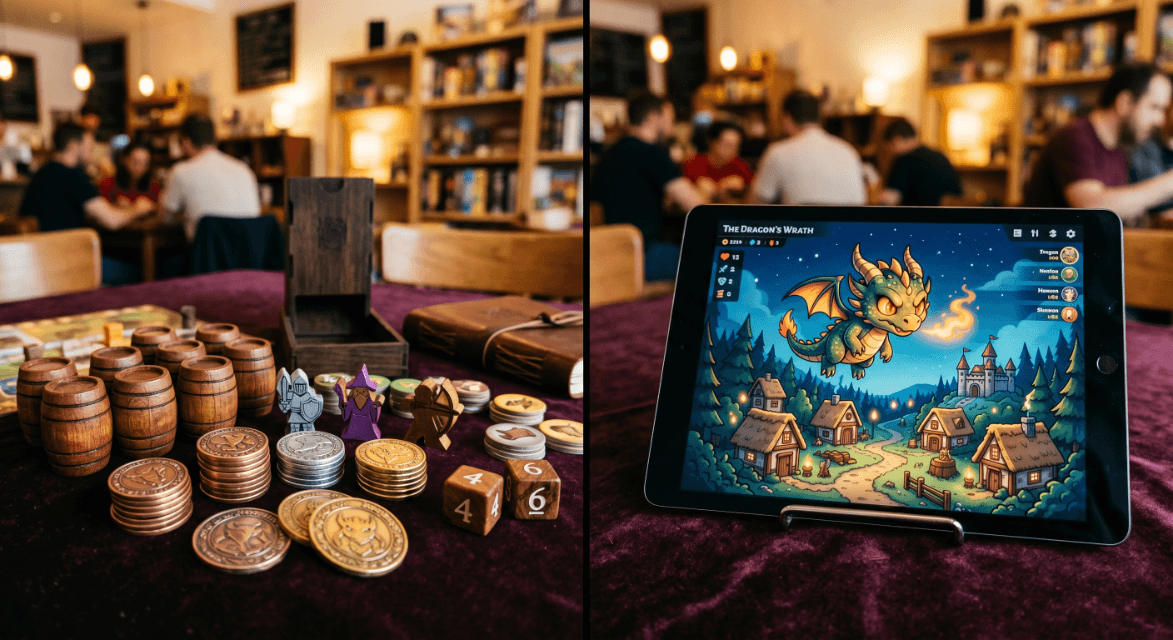
Furthermore, the integration of digital tools alongside analog games continues to expand. While the core experience remains physical, enthusiasts are increasingly turning to specialized digital platforms. For instance, utilizing a dedicated, game-specific digital score tracker for complex end-game tallying ensures absolute mathematical accuracy and provides long-term statistical tracking for dedicated gaming groups. Additionally, curating the auditory environment has become a standard practice; playing long-form, thematic ambient tracks—such as those available on the MeepleMelodies platform—establishes an immersive atmosphere that enhances focus and enjoyment during extended sessions.
The 2026 Spiel des Jahres will be remembered not only for Reiner Knizia's unprecedented and historic Triple Crown but also as a definitive statement on the purpose of modern board gaming: to build connections, foster empathy, and provide an elegant, constructive refuge in an increasingly complex world.
Sign in to rate this post.
You Might Also Like
Comments
Sign in to leave a comment
Sign In