How to Score Wingspan: Every Category, Step by Step
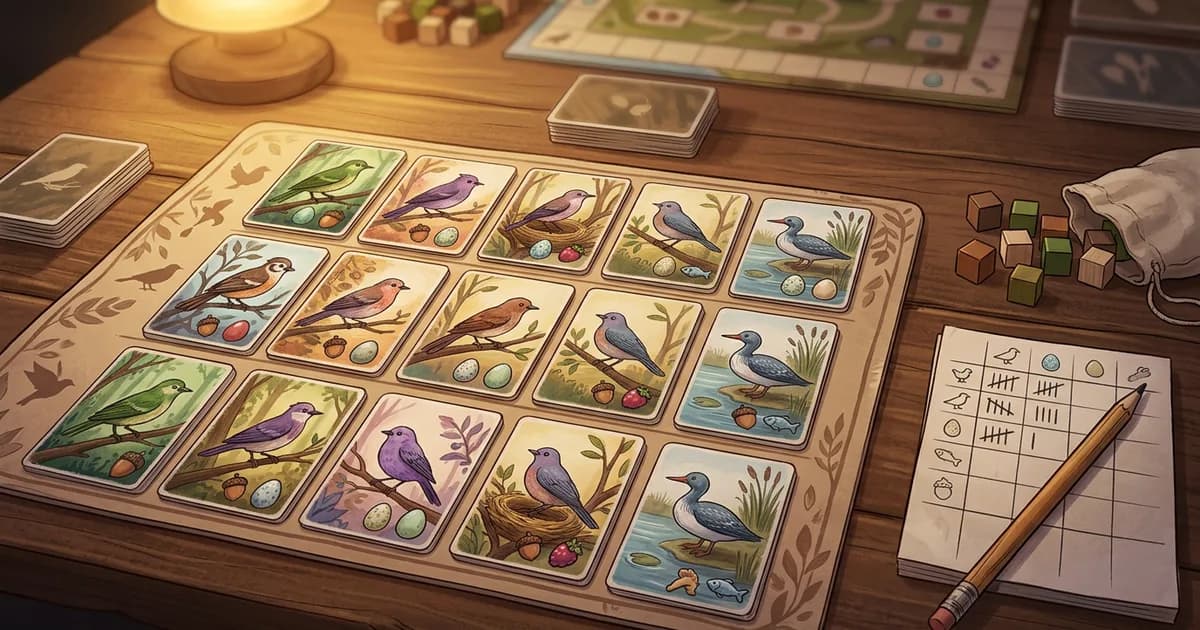
Round four just ended, the last cube is on the goal board, and everyone is staring at the score pad. Wingspan asks you to count once, at the very end, but that one count has six rows, and one of them was settled on the goal board an hour ago.
This guide shows you how to score Wingspan row by row, in the same order as the pad in the box, then walks through a full example. You don't need to have played before. If you're teaching the game tonight, read it once and you'll be the person who keeps the count honest.
How is Wingspan scored?
The game ends after round four. Each player adds up six categories, top to bottom on the score pad:
- Birds: the points printed on your bird cards
- Bonus cards: your secret objectives
- End-of-round goals: what you earned on the goal board during the game
- Eggs: 1 point each
- Food on cards: 1 point each
- Tucked cards: 1 point each
With the Oceania expansion there's a seventh row, nectar.
Go player by player, not row by row across the table. It's slower to say out loud but much harder to skip something.
Birds: add the feathers
Every bird card has a point value next to a feather icon. Add up the feathers on every bird in your three habitats: forest, grassland and wetland.
Only birds on your mat count. Cards still in your hand are worth nothing, no matter how good they are.
Bonus cards: read each one again
Everyone starts with one bonus card, chosen from two dealt at setup, and some bird powers let you draw more. Each card scores by its own condition, and there are two kinds:
- Per-bird cards pay for every qualifying bird.
- Threshold cards pay a fixed amount once you hit a number, and a bigger amount for a higher number.
Read the card out loud and count the matching birds together. A card read from memory is how a 4 turns into a 5.
End-of-round goals: copy them from the board
You don't calculate this row at the end. You already scored it four times, once at the end of each round, by placing a cube on the goal board. Now you add up your cubes.
What those cubes are worth depends on which side of the goal board you played:
| Green side (default) | Blue side (good for new players) | |
|---|---|---|
| How it works | Players are ranked on each goal | Each player counts their own items |
| Points | The value printed for 1st, 2nd or 3rd place | 1 point per item, maximum 5 |
| No points | 4th and 5th place, or none of the item | None of the item |
| Ties | Tied players share the places' points | Not needed |
On the green side, a tie leaves the next place empty. Both cubes go on the tied place and nobody takes the place below. At game end, add the points for the shared places, divide by the number of tied players and round down. The rulebook's own example: on a goal worth 5, 2 and 1, two players tied for first each get 3 points (5 + 2 = 7, halved and rounded down). Nobody scores the 2 for second.
Pro tip: At the end of each round, say each player's goal points out loud as the cube goes down. Nobody remembers round one by the end of round four.
Eggs, food and tucked cards: 1 point each
The last three rows are pure counting:
- Eggs: every egg still on a bird card.
- Food on cards: every food token cached on a bird card. Food in your personal supply scores nothing.
- Tucked cards: every card tucked under a bird.
Count them bird by bird and clear each card as you go. Lifting tokens off the card is the easiest way to avoid counting the same pile twice.
Oceania: the nectar row
Oceania adds nectar, a wild food you spend to play birds. In each of the three habitats, the player who spent the most nectar there scores 5 points and second place scores 2. Ties work like the green goal board: add the points for the tied places and split them, rounding down.
No Oceania in the box? Leave this row blank.
A full Wingspan scoring example
Two players, base game, at the end of round four:
| Row | Ada | Can |
|---|---|---|
| Birds | 38 | 41 |
| Bonus cards | 7 | 4 |
| End-of-round goals | 12 | 10 |
| Eggs | 9 | 11 |
| Food on cards | 4 | 3 |
| Tucked cards | 6 | 7 |
| Total | 76 | 76 |
Can has the stronger birds. Ada makes it up on the bonus card and the goal board. Same total, so the tiebreaker decides.
Wingspan tiebreaker rules
If two players end on the same total, the player with more unused food tokens in their supply wins. It's the only time supply food matters at scoring. If that's tied too, the players share the victory.
In the example above, Ada kept 2 food in the supply and Can kept 1. Ada wins.
Common Wingspan scoring mistakes
- Counting supply food as points. Supply food only breaks ties.
- Forgetting the goal board. Those points sit on the board, not on your mat.
- Awarding the place below a green-side tie. It stays empty.
Wingspan scoring checklist
Read this at the table, one player at a time:
- Feathers on every bird on the mat
- Each bonus card, condition read out loud
- Cubes on the goal board
- Eggs on birds
- Food cached on birds (not the supply)
- Tucked cards
- Nectar, if you play Oceania
- Tie? Most unused food wins
If the score pad ran out years ago, the MeepleShelf score tracker has a Wingspan sheet with all seven rows already labelled. Pick Wingspan, add your players, and type each player's numbers in at the end. Leave nectar at 0 if you don't play Oceania. The Wingspan page keeps a short version of this breakdown next to each row.
Next game, say the goal points out loud at the end of every round, and keep the pad next to the goal board.
Sources
- Wingspan rules, Stonemaier Games: the publisher's download page for the core rulebook (end-of-game scoring, goal board, tiebreaker) and the Oceania rulebook (nectar scoring)
- Wingspan on BoardGameGeek: game details and rules discussion
Sign in to rate this post.
You Might Also Like
Comments
Sign in to leave a comment
Sign In